
Every ABA practice eventually meets the same wall. The clinical team has a treatment plan, the schedule is full, the family is ready, and the biller opens the claim only to find that the authorization expired three weeks ago, the service type the RBT performed was not on the auth, the modifier on the claim did not match the modifier on the auth, or the units authorized for the quarter have already been consumed by sessions the clinic never billed. The visit happened. The data was collected. The note was signed. The revenue simply does not arrive.
Most of those failures are not biller mistakes. They are structural. The information that determines whether a session is billable — the authorization number, the unit balance, the CPT code, the rendering modifier, the date window, the coverage type — is scattered across the payer portal, the front-desk spreadsheet, the BCBA’s notebook, and the scheduling tool. When those sources drift apart, the practice either writes off the session or fights the payer for reimbursement that should never have been in doubt.
This guide walks through the authorization-to-billable-units chain used in Cognix Health. It explains, in plain language, how an active insurance policy funds a reservation of units, how those units attach to the services a client can receive, how a scheduled visit has to trace back to that reservation, and how unit accounting decides whether a visit can be billed. It then walks through the failure modes that turn an otherwise payable session into a write-off, and the operations practices that keep the chain intact as caseload and payer mix grow.
Complementary reading: The Complete Guide to ABA Therapy Data Collection explains the structured trial data that every session produces. ABC Incidents and FBA Reports describes the observation records that ride alongside that data. AI-Assisted Session Notes Without Leaking PHI explains how the AI documentation layer fits on top of an already-validated billable session.
What the Authorization Chain Is Actually For
An insurance authorization is not a permission slip. It is a reservation. The payer agrees, in advance, to pay for a defined set of services, performed by a defined role, with a defined CPT code, between two dates, up to a total number of units. The reservation is denominated in 15-minute units, because that is the standard increment for the ABA CPT codes (97151 through 97158 plus 0362T and 0373T). One hour of 97153 is four units. One hour of 97155 is four units. A six-month authorization for 240 units of 97153 and 96 units of 97155 is a payer commitment to fund up to 60 hours of direct technician time and 24 hours of BCBA protocol modification across the authorization window — assuming the visits are performed, documented, and submitted in the form the payer recognizes.
The reservation has a price. Every unit in use is a unit not available for the next visit. Every unit over the cap is a unit the payer will deny. Every unit denied in the first quarter for a missing modifier is a unit the family has to pay out of pocket or the practice has to absorb. The chain that connects an authorization to a single billable appointment is the chain that protects both the revenue and the family.
The Authorization-to-Billable Chain at a Glance
These figures describe what the workflow is designed to deliver for practice owners and billers as of August 2026 — a clear catalog, a standard unit, and a scheduling-time hold that keeps the remaining balance honest.
What an Authorization Actually Connects
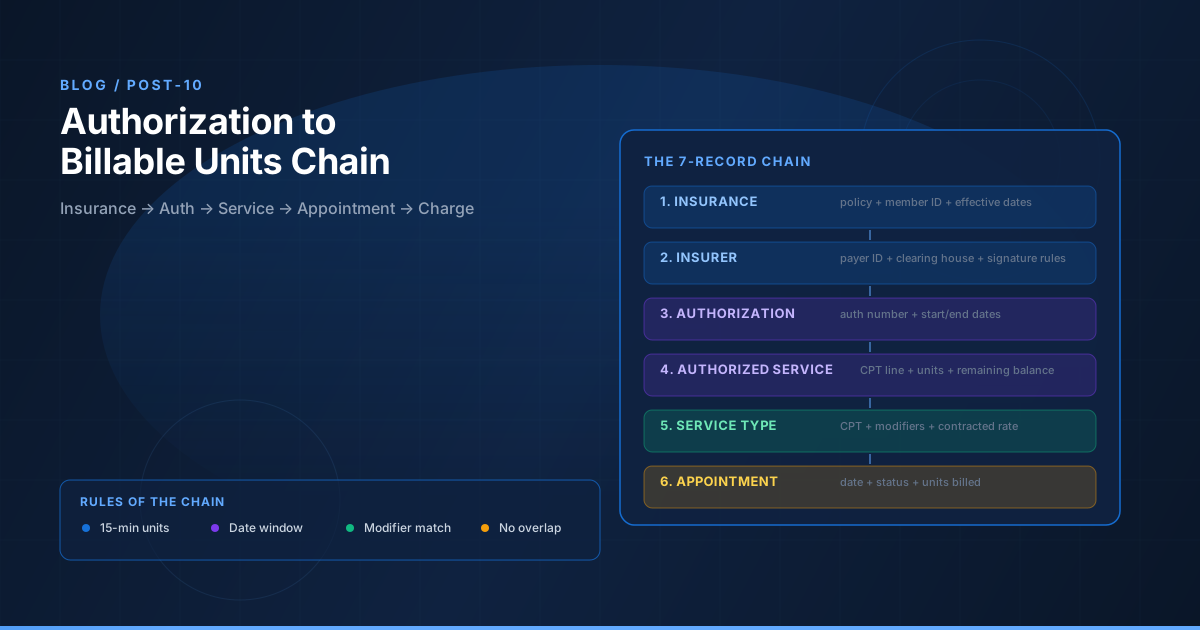
An authorization is a reservation held against a policy. It funds specific services for a specific client between two dates, up to a defined number of units. A scheduled visit has to trace back to that reservation before it is trustworthy to bill.
In practice, that means several things have to line up before a visit is ready:
- Active coverage. The patient has an insurance policy that is in force on the date of service. Multiple coverages — primary, secondary, tertiary — can exist at once, and each one is tracked separately.
- A payer with known rules. The insurer carries the rendering and submission rules that apply across every authorization and claim that payer holds.
- The reservation itself. An authorization number, a start date, an end date, and one or more service lines underneath it. A two-line authorization — 240 units of 97153 plus 96 units of 97155 in the same window — is one reservation with two funded services.
- Service lines with a running balance. Each line carries a unit ceiling and a remaining balance. Every session that consumes the line reduces that balance; every cancellation that returns units restores it.
- Client services in scope. The services the client is actually assigned to receive — for example 97153 with a U5 RBT modifier, or 97155 with a HO BCBA modifier — have to be funded by one of those lines.
- A billable service definition. The CPT code, the modifiers, the roles that can perform the service, and the contracted rate. The same practice can carry a higher contracted rate for one payer contract and a lower one for another, plus non-billable variants used for supervision-only or training-only sessions.
The insight is simple: if any of those pieces is missing or out of date, the visit may still happen clinically, but the claim will not hold.
How the Chain Connects to a Single Appointment
The chain ends at an appointment. Every appointment sits on a date, at a time, with a client, with a staff member, with a status, and with one or more services attached. The session that follows produces the data, the note, and the sign-off. The appointment is the moment where authorization, service type, and unit balance meet.
A single appointment can carry more than one service. A 90-minute direct session that includes 60 minutes of 97153 RBT delivery and 30 minutes of 97155 BCBA protocol modification produces two billable lines on the same visit. Each one draws against a different funded service. The authorization chain has to handle both lines in the same operation.
Appointment Units vs. Charged Units
Two numbers matter on every funded visit, and they are not the same thing:
- Appointment units are the units reserved when the visit is booked. A 60-minute session is four units. Those four units come off the authorization’s remaining balance at scheduling time, so the next scheduler already sees a held balance rather than a free one.
- Charged units record what the biller actually billed once the claim is accepted. Until that charge happens, charged units stay at zero — but the remaining balance on the authorization has already been reduced by the appointment units.
That split is deliberate. It lets the practice reserve inventory when the calendar fills, then record what the payer ultimately paid, without losing the audit of either step. A 60-minute session that the payer ultimately authorizes at 45 minutes (three units) can still show four units reserved and three units charged. The remaining balance moved at scheduling; the charged column records the billing outcome later.
Which Appointment Statuses Consume an Authorization
Three appointment statuses consume an authorization. Kept sessions consume. Upcoming sessions also consume, because the authorized units are reserved at the moment the appointment is scheduled, not at the moment the session is performed. No Show sessions consume in some payer contracts and not in others — Cognix Health records the appointment status as set, and the biller decides whether to charge the units based on the contract. Canceled, Late Cancel, and Rescheduled sessions do not consume the authorization, because the units are returned to the remaining balance. Time off does not consume the authorization because the appointment is not a real client visit.
The same status list is the source of the most common billing errors. A session that was kept at the time but marked as canceled afterward does not consume the authorization. A session that was rescheduled but not deleted still consumes — but against the wrong date window. The system has to enforce the status rules, and the biller has to read the system correctly.
How the Chain Decides Whether a Session Can Be Scheduled
The authorization chain is not just a billing tool. It is the gating system that decides whether a session can be scheduled at all. A new patient, a new service line, a new payer, a new authorization window — every one of those has to be in place before the scheduler can book a visit.
Before a visit is booked, the system confirms there is an active authorization covering that service on that date with units remaining, and shows the scheduler the authorization number and the balance. “Authorization #AET-2026-0188 has 18 units available between 01/01/2026 and 06/30/2026” is the message that tells the scheduler the visit can be booked. “No valid authorization available” is the message that tells the scheduler the visit cannot be booked without an override.
Some services can be scheduled without an authorization — intake visits, coordination visits, or telehealth during a coverage transition. That override is an administrator-only grant. The combination of a service-level flag and a restricted override is what prevents the front desk from accidentally booking a session the biller will not be able to charge.
How the Chain Consumes Units Over Time
The unit accounting is the part of the chain that runs continuously. Every appointment that is created, modified, completed, or canceled can change the remaining balance. The balance is the live inventory, and the inventory has to stay accurate.
The central rule: units are reserved when a visit is booked, not when the claim goes out.
At Scheduling Time
When a session is scheduled, the appointment units are recorded and the authorized service’s remaining balance is reduced by those units. The remaining balance is now a reservation, not a free balance. The session is scheduled against a held number of units, and the biller knows what the session is worth before it is performed.
At Session Time
When the session is performed, the appointment status is set to Kept. The appointment units are unchanged. The charged units are still zero. The remaining balance on the authorization is still reduced by the appointment units. The reservation is intact.
At Charge Time
When the biller creates a claim and the payer accepts the claim, the charged units are set to the appointment units. The remaining balance on the authorization is unchanged at this point — the units were already deducted at scheduling time. The audit row records the charge.
At Cancellation Time
When an appointment is canceled, late-canceled, or rescheduled, the reservation is released and the remaining balance is increased by the appointment units. If the appointment is rescheduled, a new reservation is created against the new appointment at the new scheduling time.
When an Authorization Arrives Late
When an authorization arrives after sessions were already scheduled, those sessions are reconciled against it automatically so nothing is lost. The biller does not lose revenue, and the session does not lose its place in the queue.
The Service Type Catalog
The service type is the most consequential piece of the chain, because it defines what the practice can bill for and under what rules. The standard catalog covers the ABA CPT codes the field actually uses, plus the modifiers that distinguish who delivered the service and where.
The Standard ABA CPT Codes
The American Medical Association published six new CPT codes for adaptive behavior services in 2019, and two additional codes for destructive behavior treatment in 2020. The codes are the operational vocabulary of ABA billing. Cognix Health ships with the full standard set seeded:
| CPT code | What the service is | Who delivers it |
|---|---|---|
| 97151 | Behavior identification assessment, face-to-face with patient and caregivers, plus analysis and report preparation | Qualified healthcare professional (BCBA, BCBA-D, psychologist, physician) |
| 97152 | Behavior identification supporting assessment, face-to-face with the patient | Technician under the direction of a qualified professional |
| 97153 | Adaptive behavior treatment by protocol, face-to-face with one patient | Technician under the direction of a qualified professional |
| 97154 | Group adaptive behavior treatment by protocol, face-to-face with two or more patients | Technician under the direction of a qualified professional |
| 97155 | Adaptive behavior treatment protocol modification, with simultaneous direction of technician | Qualified healthcare professional (BCBA, BCBA-D, psychologist, physician) |
| 97156 | Family adaptive behavior treatment guidance, with or without the patient present | Qualified healthcare professional (BCBA, BCBA-D, psychologist, physician) |
| 97157 | Multiple-family group adaptive behavior treatment guidance, without the patient present | Qualified healthcare professional (BCBA, BCBA-D, psychologist, physician) |
| 97158 | Group adaptive behavior treatment with protocol modification, face-to-face with multiple patients | Qualified healthcare professional (BCBA, BCBA-D, psychologist, physician) |
| 0362T | Behavior identification supporting assessment for destructive behavior, with two or more technicians in a customized environment | Technician team under a qualified professional on site |
| 0373T | Adaptive behavior treatment with protocol modification for destructive behavior, with two or more technicians in a customized environment | Qualified professional with qualified technician team on site |
The CPT code is the legal identifier on the claim. The CPT description is the operational definition the payer uses to decide whether the visit is medically necessary. The rendering role is the credential the payer uses to decide whether the visit is eligible for the contracted rate. The right combination is the difference between a paid claim and a denied claim.
The Standard Modifier Set
Modifiers are the two-character suffixes that ride on the CPT code and change the meaning of the service. The standard ABA modifier set distinguishes the rendering provider’s credential, the location of the service, and the modality (telehealth vs. in-person). Cognix Health ships with the standard set seeded:
| Modifier | What it identifies | Common use in ABA |
|---|---|---|
| U1 | Physician or psychiatrist | Psychiatric consults embedded in treatment |
| U2 | Psychologist or BCBA-D | Doctoral-level clinical services |
| U3 | BCBA | Master’s-level certified behavior analyst |
| U4 | BCaBA | Bachelor’s-level assistant behavior analyst |
| U5 | RBT | Registered behavior technician direct delivery |
| U6 | Office | Services performed in the clinic |
| U7 | Home | Services performed in the home |
| HO | BCBA | Alternate BCBA modifier used by some payers |
| HN | At least bachelor’s degree plus BCaBA | Credential-level modifier for BCaBA practitioners |
| HM | Less than bachelor’s degree | Credential-level modifier for technicians without a degree |
| GT | Telehealth (legacy) | Synchronous audio-video telehealth under older payer rules |
| 95 | Telehealth (current) | Synchronous audio-video telehealth under current AMA guidance |
The same CPT code with a different modifier is a different service to the payer. 97153 with a U5 is RBT direct delivery. 97153 with no modifier is the same code billed at the qualified-professional rate. The modifier is the lever that distinguishes them on the claim.
Clinical Labels vs. Billing Codes
Schedulers think in clinical labels — Assessment, 1:1 Service, Social Skills, Protocol Modification, Parents Training. Billers think in CPT codes. Both views have to coexist on the same service definition so the front desk and the billing office are not working from two different catalogs.
Worked Example: One Patient, Two Authorizations, Three Months
The best way to see the chain is to walk it. Below is a realistic scenario that shows how coverage, authorization, scheduling, and claims stay aligned — without treating the platform as a blueprint.
The setup. A four-year-old patient is admitted with Commercial coverage (primary) and Medicaid (secondary). The clinic assigns 97153 with a U5 RBT modifier and receives a six-month Commercial authorization for 240 units of 97153 between January 1 and June 30. That authorization is recorded with its window and unit balance before the first visit is booked.
The schedule. The RBT is scheduled for 10 hours per week of 97153 delivery. The scheduler picks the client, the service, and a date. The system confirms an active authorization covering that service on that date with units remaining, shows the authorization number and the balance, and books the visit. One hour reserves four units. The remaining balance drops from 240 to 236 at scheduling time.
The second service. The BCBA also needs 97155 protocol modification sessions, two per month. A separate Commercial authorization for 96 units of 97155 is approved in the same window. Because the two authorizations fund different services, they can coexist without colliding.
The first month. The RBT delivers 40 hours of 97153 = 160 units. The remaining balance is now 80 units after the month’s reservations. The BCBA delivers 8 hours of 97155 = 32 units, leaving 64. Every kept session was reserved at scheduling time; charged units stay at zero until the biller creates the claim.
The claim. The biller submits the 97153 sessions with the authorization number, CPT code, modifier, units, dates of service, and contracted rate. The payer accepts the claim. Charged units are recorded to match what was billed. The remaining balance does not move again at charge time — those units were already deducted when the visits were booked.
The end-of-quarter check. The biller reviews both authorizations. The 97153 line still has room for the rest of the window. The 97155 line is on track. The authorization has not been exhausted. The chain is intact.
The branch. In February, the family changes insurers. Commercial coverage is deactivated. Medicaid requires a new authorization. The clinic obtains approval for 200 units of 97153 between March 1 and August 31. The old reservation is closed for audit purposes, the new one is opened with a fresh balance, and care continues without a scheduling gap.
The Audit Trail the Chain Leaves Behind
Every meaningful change in the chain should be reconstructable later: who created the authorization, when the units were reserved, what was charged, which services were delivered, and who signed off. That history is what the practice relies on when a payer asks for documentation of a denied claim. The chain is only as strong as the audit that can defend it.
Common Failure Modes and How to Avoid Them
The chain is reliable, but only when coverage, authorization, service assignment, and unit balance stay in sync. The most common failure modes are familiar to every biller who has worked a denied-claim day.
1. The Authorization That Exists But Is Not Linked
The practice schedules a session against a service and a client, but the authorization is not active on the date of service. The session is performed, units are reserved, but the claim is denied because the authorization is dated to a different window. The fix is to enforce the chain check at scheduling time, not at billing time. The scheduler has to see the authorization number, the date window, and the unit balance before the appointment can be saved.
2. The Service Type That Does Not Match the Auth
The practice schedules a session for 97153 with a U5 modifier, but the authorization is for 97153 with no modifier. The session is performed, the claim is denied because the modifier on the visit does not match the modifier on the auth. The fix is to enforce the modifier check at scheduling time. The client’s assigned service has to point at an authorization line that includes the modifier the visit will use.
3. The Authorization That Is Exhausted Early
The practice schedules sessions at the planned cadence, but the planned cadence exceeds the authorized units. The remaining balance hits zero, the next appointment is booked against a zero balance, and the chain shows nothing available. The fix is to enforce the unit check at scheduling time. If the balance is insufficient, the scheduler either picks a different service, picks a different date, or waits for an authorization renewal.
4. The Authorization That Is Renewed Without Reconciling Pending Visits
The practice renews an authorization for a new window, but earlier sessions were already on the calendar waiting for coverage. If those visits are not reconciled against the new reservation, the new balance looks healthier than it is and runs out in the first month. The fix is to reconcile pending visits when the new authorization is created, so the remaining balance the scheduler sees already accounts for what was already booked.
5. The Service That Is Scheduled Without an Authorization When It Should Not Be
The practice leaves the schedule-without-authorization override open on a service that should require coverage. The scheduler books a session with no underlying auth, the session is performed, the claim is denied, and the family is billed for the difference. The fix is to keep that override restricted to the services that genuinely need it — intake, coordination, transition telehealth — and to keep the grant itself limited to administrators.
6. The Cancellation That Does Not Return the Units
The practice cancels an appointment, but the remaining balance is not updated. The next session is scheduled against the same authorization line, but the units are still held by the canceled appointment. The cancellation has to release the reservation at the same moment the appointment status changes, not as a follow-up task.
7. The Service Type That Is Created Without a Contracted Rate
The practice creates a service type, schedules a session, performs the session, and submits the claim. The claim is denied because the service has no contracted rate with the payer. The fix is to require a contracted rate before a service can be treated as billable.
8. The Service Type That Is Created Without a Modifier Set
The practice creates a service type with a CPT code but no modifier. The claim is submitted with the CPT code and a blank modifier. The payer denies the claim because the modifier is required. The fix is to require the modifier set when the service is defined. A U5 RBT service needs the U5. A telehealth service needs the 95 or GT. The modifier is the lever the payer uses to apply the contracted rate.
9. The Authorization That Is Edited After Sessions Have Been Charged
The practice edits an authorization to extend the end date, but the remaining balance is not adjusted for the sessions that have already been reserved or charged. The balance is wrong, the next session is refused, and the chain looks broken. The fix is to recalculate the remaining balance from active reservations whenever the parent authorization is edited.
10. The Authorization That Is Deleted With Pending Appointments
The practice tries to delete an authorization that still has active appointments attached. Deletion should be blocked until those appointments are canceled, billed, or moved. A silent deletion leaves orphan reservations the biller has to clean up later.
Best Practices for Keeping the Chain Intact
The chain is not a single record. It is a pattern that requires discipline to maintain. The practices that keep it intact are the ones the most efficient billing operations have built over years of trial and error.
- Create the authorization before the first session. The first session cannot be scheduled — and cannot be billed — until the reservation is recorded. The first denied claim is the cost of recording the authorization after the first session.
- Assign the client’s services before linking them to an authorization. Coverage has to reach the specific services the client will receive. The order matters: client services first, then the funded lines that cover them.
- Use the schedule-without-authorization override sparingly. It is an administrator-only grant for the services that genuinely need to be booked before coverage is in place — and only for those.
- Review the remaining balance monthly. How many units are left, what is the cadence of consumption, will the authorization be exhausted before the end date, and do we need to request a renewal? That review is the early warning system.
- Audit the chain after every payer change. Deactivate the old coverage, close the old authorization, create the new coverage and authorization, and verify the client’s services still point at a live reservation before the next session is scheduled.
- Run the authorization check before billing. Confirm the authorization is active, the service is in scope, the modifier is correct, the units are within the balance, and the dates of service are inside the window.
- Keep the service catalog aligned with payer contracts. The same CPT code can be billed under different modifiers and different rates for different payers. Carry one definition per combination the practice actually bills.
- Keep a history of contracted rate changes. When a payer contract renews, record the old rate, the new rate, and the effective date so a retroactive adjustment can be reconstructed.
- Train the schedulers on the chain. The scheduler sees the authorization number, the remaining balance, the date window, and the service. A scheduler who treats authorization as a back-office concern books sessions that cannot be billed.
- Run the chain end-to-end during onboarding. Coverage, client services, authorization, funded lines, and the first scheduled session should all be verified before the first session is performed.
Common Mistakes and How to Avoid Them
How Cognix Health Supports the Authorization Chain
Cognix Health treats the authorization chain as one connected workflow, not a sequence of disconnected screens. Coverage, authorization, client services, scheduling, and billing all see the same remaining balance.
The workflow includes:
- Coverage-to-visit continuity — an active policy funds a dated reservation of units for specific services, and a scheduled visit has to trace back to that reservation
- Schedule-time unit holds — units are reserved when a visit is booked, so the remaining balance the next scheduler sees is already honest
- Late-authorization reconciliation — when coverage arrives after sessions were already scheduled, those visits are reconciled automatically so nothing is lost
- Administrator-only override — out-of-auth booking is limited to services that genuinely need it, and only administrators can grant it
- Balance recalculation on edit — changing the total units or the date window recalculates the remaining balance from active reservations
- Deletion protection — an authorization with active appointments cannot be removed until those appointments are canceled, billed, or moved
- Standard ABA catalog — the CPT codes and modifiers practices actually bill, seeded and ready to align with payer contracts
- Overlap detection — refuse a second authorization for the same client, insurer, and service when the date windows collide
- Contracted rate history — reconstruct the rate that was in force on the date of service
- Appointment units vs. charged units — reserve inventory at scheduling time, record what was billed later, keep the audit of both
The goal is to keep the chain honest. The scheduler sees the chain. The biller sees the chain. The auditor sees the chain. The payer sees the claim. The family does not see the chain, but the family sees the result: a clean claim, a paid visit, and a treatment plan that continues without interruption.
Want to see how the authorization chain fits your billing workflow? Contact Cognix Health to schedule a demo.
Frequently Asked Questions
What is the difference between an authorization and an authorized service line?
An authorization is the parent reservation — the payer’s commitment to fund a defined set of services for a defined client within a defined date window. An authorized service line is one funded CPT code with a specific unit ceiling. A two-line authorization for 97153 and 97155 has one reservation and two funded lines under it. The parent governs validity; the children govern unit accounting.
How does the system know if a service is in scope for an authorization?
Before a visit is booked, the system confirms there is an active authorization covering that service on that date with units remaining. If the chain is complete, the scheduler sees the authorization number and the balance. If anything is missing, the scheduler sees that no valid authorization is available.
What happens when an authorization expires?
The remaining balance stops being available for new bookings. Historical balances stay visible for audit. Renewal is a new authorization with a new start date, a new end date, and a new unit allocation. Sessions already charged against the old authorization are unchanged.
Can a single authorization cover multiple service types?
Yes. One reservation can carry multiple funded service lines. A single authorization can cover 97153 and 97155 in the same window without treating them as duplicates.
What happens when the schedule-without-authorization override is enabled?
The scheduler can book that service without an active authorization, but only when an administrator has granted the override. The combination is what prevents accidental out-of-auth booking for services that should require coverage.
How does the system handle appointments that were scheduled before the authorization arrived?
Those sessions are reconciled against the new authorization automatically so nothing is lost. The remaining balance the scheduler sees already accounts for what was already booked.
Can an authorization be edited after appointments have been charged?
Yes. Extending the date window, updating the authorization number, or changing the total units is allowed. The remaining balance is recalculated from active reservations so it stays accurate after the edit.
What happens when an authorization is deleted?
Deletion is blocked while active appointments are still linked. Those appointments have to be canceled, billed, or moved to a different authorization first.
How are modifiers applied to the claim?
The service definition carries the modifier set. The claim reads the modifier from the service on the visit, so the modifier on the claim matches what was scheduled and what the authorization funded.
What is the role of the contracted rate history?
It records the rate that was in force on the date of service. When a payer contract changes, the new rate is added with an effective date and the old rate is closed. The biller can reconstruct the rate that applied during a transition window.
Can a single authorization cover visits performed under different modifiers?
Yes. One funded service line can cover more than one client service assignment. A 97153 line can fund both a U5 RBT visit and a no-modifier visit when both assignments are in scope.
What happens when a patient changes insurers?
The old coverage is deactivated, the old authorization is closed for audit, the new coverage and authorization are created, and the client’s services are pointed at the new reservation before the next session is scheduled.
How does the system prevent duplicate authorizations?
It refuses a second authorization for the same client, insurer, and service when the date windows overlap. The check happens at creation time, not at billing time.
What is the difference between appointment units and charged units?
Appointment units are reserved when the visit is booked and are what move the authorization’s remaining balance. Charged units record what the biller actually billed once the claim is accepted. Both numbers exist; only appointment units move the balance, and they move at scheduling.
How does the chain interact with the appointment status?
Kept and Upcoming consume an authorization. No Show may consume depending on the payer contract. Canceled, Late Cancel, and Rescheduled return the units. Time off does not consume the authorization because it is not a client visit.
How does the chain interact with the AI-assisted documentation layer?
The AI documentation layer only sees sessions that have already passed the authorization chain. It writes the narrative, not the billing. Identifiers are removed before the model is called. Billing stays with the chain. The two layers are independent by design.
This guide reflects Cognix Health authorization and service type configuration as of August 2026. Clinical teams should use their organization’s payer contracts, authorization procedures, billing standards, and applicable state and federal requirements when configuring service types and authorizations. The chain is a workflow, not a substitute for a managed care contract. For questions about how Cognix Health supports the authorization-to-billing chain for ABA workflows, reach out to our team at [email protected].