
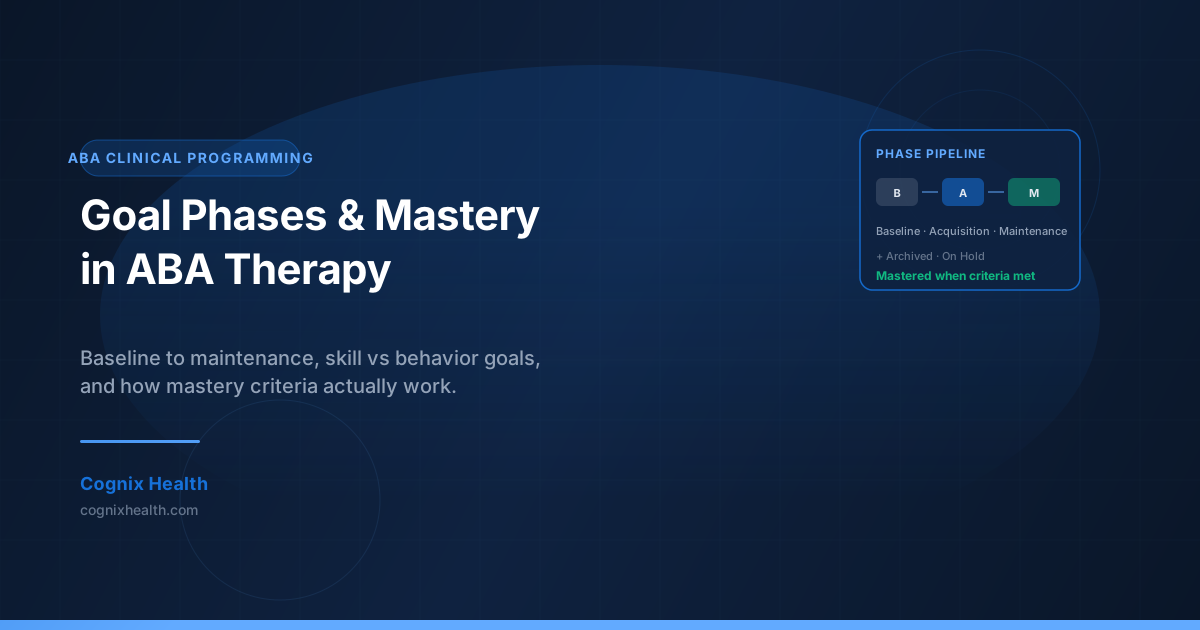
Data collection answers what happened in the session. Goal phases and mastery criteria answer what the client has earned the right to leave behind — and what still needs active teaching.
Every BCBA has lived the spreadsheet version of this problem. A target is “almost mastered” for weeks. One RBT scores 90%, another scores 70% on the same SD. A parent announcement is drafted, then a bad day resets the chain. Or the opposite: the chart looks fine, the target moves to maintenance, and a relapse is discovered three weeks later during a utilization review.
This guide is a full lifecycle map of ABA programming states — baseline, acquisition, maintenance, archived — plus the clinical distinction between skill goals and behavior goals, the parameters that define mastery (percentage, minimum trials, multi-day streaks, baseline criteria), and the operational guards mature software needs so automatic promotion never paints over clinical judgment.
Complementary reading: our complete guide to ABA data collection methods covers the seven target types that feed these phase decisions.
Why Goal Phases Are a Clinical Control System
Phases are not cosmetic labels on a chart. They encode decisions about:
- What data matters next (establish a true baseline before teaching; prove generalization before archive)
- How much session time to allocate (acquisition targets get density; maintenance can thin probes)
- What payers and auditors will accept as medical necessity evidence of progress
- When staffing models can step down (less 1:1 intensity after reliable maintenance)
Get the phase wrong and you allocate the wrong dose. Keep everything forever in “teaching” and you overserve, crowd schedules, and inflate cost per client. Graduate too early and you risk skill loss, parent dissatisfaction, and denials when outcomes are uneven.
The Hidden Cost of Ambiguous Programming States
The Four Programming Phases (Exhaustive Model)
A rigorous ABA platform models four named phases for client–goal–target mappings — not a free-text status field. In practice those phases are:
| Phase | Clinical intent | Typical data posture |
|---|---|---|
| Baseline | Measure performance before intensive teaching | Dense enough sample, limited prompts/teaching collapses integrity |
| Acquisition | Active instruction, shaping, prompting, differential reinforcement | Daily probes/trials with instruction present |
| Maintenance | Performance holds after teaching intensity drops | Scheduled sparse probes; watch for relapse |
| Archived | No longer active on the treatment board | Historical evidence retained; not in active session card by default |
These four values form the phase model every structured goal should support: baseline, acquisition, maintenance, and archived. Two related but orthogonal operational flags also matter:
- On hold — temporarily suspended without destroying history or mastery metadata
- Mastered status and mastery date — a record of achievement; usually coincides with promotion into maintenance
On-hold and archive are not substitutes for “not mastered.” Confusing them is one of the most common sources of silent data corruption in half-built tools.
Phase Cheatsheet for Caseload Reviews
- Baseline too thin → you cannot defend acquisition progress against critics or authors of second opinions.
- Acquisition without mastery criteria → the team will indefinitely “teach a little more.”
- Maintenance without probes → false confidence and hidden skill decay.
- Archive without sequence of outcomes → charts that look tidy but fail utilization review.
Skill Goals vs Behavior Goals — Two Different Clinical Objects
ABA software that collapses “goals” into one table shape eventually lies to clinicians. Skill acquisition and behavior reduction are different clinical contracts.
Skill goals
Skill goals teach new repertoire (mands, tacts, motor imitation, ADLs, academic operants). In a structured system:
- A skill goal has one or more targets under it
- Each target has its own target type (DTT, task analysis, interval for skill endurance, etc.)
- When a session runs, each target keeps its own independent trial answers and criteria
- Mastery is usually evaluated per target, not only per goal title
Example: goal “Independent completing two-step morning routine” might contain targets for (1) hang backpack, (2) put lunchbox away, (3) sit for morning meeting — each with its own DTT or task-analysis configuration.
Behavior goals
Behavior goals track problematic or competing repertoires you intend to reduce or replace (aggression, elopement, SIB, stereotypy under certain conditions). In a structured system:
- Behavior goals typically attach response type (frequency, duration, etc.) on the goal itself
- There is no nested target tree required — answers hang on the goal
- Default phase is often acquisition when injected into a fresh session (you are actively managing the behavior pathway)
- ABC incident logs commonly link to a behavior goal and update its session trial data automatically
- Goal type:
Skill - Has nested targets
- Per-target mastery parameters
- Baseline criteria often per target
- Promote targets to maintenance independently
- Goal type:
Behavior - Response type on the goal (freq/duration…)
- Answers array on the goal
- Often linked to ABC incidents
- Reduction / replacement success rules differ from skill %
Why this matters for transitions: automatic mastery jobs that only flatten DTT/Task Analysis/Toileting scorable data will primarily advance skill targets. Frequency and duration behave differently — “success” on a reduction goal is often lower rate or shorter bouts, not higher percent correct. Clinicians should design reduction criteria explicitly; never pretend every goal uses 80% independent.
Mastery Criteria — Every Parameter That Actually Exists
“80% for 3 sessions” is folklore, not a complete specification. A production-ready model exposes all of these parameters on a target (or baseline criteria object), with sensible defaults and clinical overrides:
Acquisition / teaching mastery parameters
| Parameter | What it means | Example default used in real systems |
|---|---|---|
| Mastery percentage | Correct / total × 100 must meet or exceed this | 80% |
| Minimum trials (within a session/day) | Not enough data? Do not pass that day | 3–10 depending on program |
| Desired trials | Target density for a productive teaching session | 5 (configurable) |
| Mastered over (days / sessions) | How many successful days in a row (or count) required | 3 |
| Consecutive correct (baseline) | Whether correct responses must form a consecutive string | false by default |
| Minimum correct (baseline) | Absolute correct count for baseline exit | 9 of 10 style rules |
In Cognix Health specifically, defaults that appear as starting points include:
- Baseline minimum trials: 10
- Baseline minimum correct: 9
- Consecutive correct for baseline: false by default
- Desired trials: 5
- Mastered-over days: 3
- Mastery percentage: 80%
Treat defaults as starter templates, not scientific law. Toilet training, echoics in EIBI, and vocational discrimination programs rarely share the same thresholds.
Common Mastery Spec Failures
- % without a minimum N — three lucky trials at 100% “masters” a skill.
- Same-day multi-session double counting — the afternoon session “saves” a failed morning without an honest day-level gate.
- No multi-day requirement — one good day graduates the target after a rocky month.
- Looking only at last 5 trials while ignoring the rest of a noisy day.
- Ignoring on-hold periods so a client “masters” a skill while absent for illness.
- Applying skill % rules to reduction goals — concise accidental reinforcement of the wrong metric.
How Automatic Mastery Should Work (Day-Level Engine)
A trustworthy engine does not master on a partial afternoon save. It evaluates in layers.
Layer 1 — Prevent partial-day awards
Before evaluating mastery for a client on a given calendar date, verify that completed sessions ≥ scheduled appointments for that client/org/day. If the day is only half reported, defer. Premature promotion generates false maintenance.
Layer 2 — Evaluate each day for each target
For each unique goal–target pair measured in the day's sessions:
- Flatten scorable answers (DTT, Toileting with correctness flags, Task Analysis per-step correctness).
- For every completed session that day containing the target:
- Require attempts ≥ minimum trials.
- Compute % correct from scorable rows.
- Fail the day if any completed session that attempted the target falls below criteria (strict day integrity differs by product design; the important point is transparency and consistency).
- Each day ends in one of three states:
- Met — the day satisfied criteria
- Failed — the day did not satisfy criteria
- No attempt — no completed data for that target
Layer 3 — Multi-day streak (“mastered over”)
If today is a pass and the target is not already marked mastered:
- Count consecutive past successful days, stepping backward calendar-wise
- Gaps with no data often do not break the streak; a failed day does
- Cap lookback (e.g., 60 days) so the system never infinite-loops history
- When the successful-day count reaches the mastered-over threshold, the system records the target as mastered, stamps the mastery date, and moves it into maintenance
That triple step is the clean product contract: mastery is not just a badge; it is a phase transition.
Layer 4 — Human override still wins
Product rule that keeps trust:
- Automatic paths may award mastery.
- Automatic paths should never un-master.
- Un-mastering is a deliberate clinician action (“Mark as not mastered”), with honor of consequent phase decisions and documentation.
On-hold and archive flows must not silently clear the mastered flag just because mastery was never re-specified in that action. That failure pattern appears in real production bug reports and is one of the reasons clinics stop trusting “smart” systems.
Baseline Criteria — Separate from Acquisition Mastery
Baseline is not mini-acquisition. Its job is pre-teaching measurement with explicit integrity rules.
A baseline criteria bundle typically includes:
- A minimum number of trials
- A minimum number correct
- An optional consecutive-correct requirement
Example clinical rule: Baseline requires 10 trials with at least 9 correct and the consecutive-correct rule off (percent style), OR 3 consecutive independent responses depending on curriculum.
Why separate objects matter:
- You can change acquisition mastery % without rewriting baseline exit rules
- Assessments and FBA-linked baselines can use different N and consecutive flags
- Session construction still injects baselineCriteria onto each skill target so the RBT UI and on-device scoring know which rule is active
Worked Example — Receptive ID Color “Blue”
| Setting | Value |
|---|---|
| Goal type | Skill |
| Target type | DTT (Independent / Prompted / Incorrect) |
| Phase start | Baseline |
| Baseline criteria | 10 trials, 9 correct, consecutive off |
| Acquisition mastery | 80%, minimum trials 5, mastered over 3 days |
| Desired trials / session | 5–10 |
Sequence:
- Baseline sessions establish that independent “blue” is ~20%.
- Phase moves to acquisition; teaching intensifies.
- Day 12–14: each day ≥5 trials and ≥80% independent → streak hits 3 → is_mastered true, phase maintenance, mastered_on set.
- Maintenance probes thrice weekly for two weeks; if collapses, clinician may un-master reverse to acquisition — manually, not by a random correction job.
Operational States Beyond the Four Phases
On hold
Use when:
- Medical absence
- Environmental instability
- Temporary staffing limits
- A priority target must yield session time to a crisis program
Expectations:
- Keep history, prior mastery flags, and criteria configuration.
- Do not re-inject as active teaching focus until released.
- Do not clear the mastered flag as a side effect of placing a target on hold.
Archived
Use when:
- Goal/target is no longer clinically active
- Replaced by a higher-order skill
- Program redesign retires an item
Expectations:
- Retain for audit and longitudinal graphs
- Omit from default live data-entry strips
- Avoid silent cascade that erases mastery timestamps
Mastered without maintenance discipline
If software marks mastery but does not surface maintenance probes, you create virtual success. Payers notice when medical-necessity letters claim progress that graphs cannot defend under sparse sampling.
Designing Criteria by Goal Class
Skill DTT
- Percent + min trials + multi-day streak usually enough
- Track prompt level even if how correctness is scored uses Independent vs other
Task analysis
- Per-step correctness can be flattened to % steps correct, or require all critical steps independent
- Decide whether total step-cards or whole-chain passes define the day
Toileting
- Specialized response values (On Toilet / Dry / Accident) still produce scorable correctness for promotion engines when modeled carefully
- Combine with void pattern logs parents / schools provide outside sessions
Frequency / duration behaviors
- Prefer rate change relative to baseline average or absolute threshold (e.g., fewer than 2 instances per hour across 3 days)
- Encode reduction success as criteria objects tied to direction, not default % correct
Anecdotal / unstructured
- Rarely belongs in automatic mastery pipelines
- Use for qualitative clinical notes, context for phase changes decided by humans
Best Practices for Phase Governance
- Write the criteria before the first acquisition session — not after three weeks of merely “good-looking” data that feels mastered.
- Train IOA on phase definitions the same way you train IOA on SDs.
- Separate baseline templates from acquisition templates in your library.
- Review deferred mastery queues daily — days waiting on incomplete session reporting hide true progress.
- Require a human confirmation path for high-stakes goals (safety skills, community gatekeeping skills) even if automation passes.
- Graph phase change points as clear markers on visual analysis — awards without phase annotations confuse the team.
- Document un-master events with reason codes (illness regression, program change, measurement redesign).
- Keep skill and behavior boards distinct so reduction work cannot “master” with skill defaults by accident.
Common Mistakes Grid
Digital Systems That Deserve the Phrase “Mastery Tracking”
Spreadsheet automation and consumer checklists stop at percent. Clinic-grade systems must:
- Model four phases plus on-hold without losing mastery metadata
- Differentiate skill vs behavior data shapes in session JSON
- Capture mastery parameters per target and baseline criteria as first-class records
- Run day-complete gates before awards
- Support multi-day mastery windows with configurable lookback
- Flip phase to maintenance on award, timestamps included
- Prohibit automatic un-master; keep clinician override
- Surface deferred days for ops (incomplete session notes blinding progress)
- Preserve Phase/mastery history for audits and AI narratives
- Integrate ABC linkage so behavior programs stay coherent with incident logs
When those pieces lock together, “what is on this kid’s board and why” stops being a Friday mystery meeting and becomes a continuous, defensible clinical state machine.
How Cognix Health Supports Goal Phases & Mastery
Cognix Health models programming state as a structured system — not sticky notes on a caseload spreadsheet.
- Four explicit client programming phases — baseline, acquisition, maintenance, and archived — applied consistently to client–goal–target mappings across web and mobile
- Skill vs Behavior goal shapes — skill goals nest targets with per-target criteria; behavior goals carry response types and answers on the goal, ready for ABC linkage
- Configurable mastery parameters — mastery percentage, minimum trials, desired trials, mastered-over days, and baseline criteria (minimum trials/correct, consecutive correct)
- Session-time criteria — when a session opens, each target carries its own mastery and baseline settings so technicians score against the real program, not a memory of last supervision
- Automatic mastery evaluation after session notes — day-complete gates, multi-day streak counting, maintenance promotion with a stamped mastery date
- Clinician overrides — manual master / un-master, on-hold, and archive without silent data loss when implemented with careful action contracts
- Shared analytical graphing — phase and mastery events sit on the same data spine as trial types and methods
When phases, mastery, trial data, ABC incidents, and documentation share one backbone, clinical progress stops being software-dependent folklore.
Want to see programming boards and mastery automation on your real caseload shapes? Contact Cognix Health to schedule a demo.
Frequently Asked Questions
What is the difference between acquisition and maintenance in ABA?
Acquisition is active teaching with dense instruction and data. Maintenance is demonstrated continued performance after teaching intensity drops, usually with scheduled probes. Good systems record the transition date and keep both states graphable.
How many days should mastery require?
There is no universal number. Many skill programs use 2–5 successful sessions or calendar days after each day has met percent + minimum trial rules. Higher-stakes community or safety skills often require longer, more varied probes.
Should baseline use the same percentage rule as acquisition?
Usually not. Baseline is often shorter-window measurement with different integrity constraints (limited teaching, fixed probes). Storied defaults like 9 of 10 correct or N trials take priori shape from curriculum packages, not from the acquisition mastery % alone.
Why do skill goals and behavior goals need different structures?
Skill goals build repertoires via nested targets and correctness. Behavior goals track rates or durations (often down) and frequently connect to ABC incident documentation. Collapsing them forces reduction goals through skill % logic — a clinical error waiting for an audit.
Can software un-master a goal automatically if performance tanks later?
It should not as a silent default. Clinicians may reverse mastery after true regression, but supervision documentation should accompany the decision. Nightly jobs that flip maintenance back to acquisition without intent destroy trust and contaminate payor timelines.
What if a day has two sessions, morning passes and afternoon fails?
Treat the day as a unit under a published policy. Many strict engines fail the day if any completed attempt that day fails criteria; others average. The absolute requirement is consistent, documented, automatable rules — not charm.
How does on-hold differ from archived?
On-hold is temporary suspension of active programming with history preserved. Archived means the item is no longer part of the active treatment library for the client, while remaining available for statutory and clinical history.
Do all seven data collection methods feed automatic mastery the same way?
No. Scorable percent-style methods (DTT, task analysis steps, some toileting models) fit percent + multi-day engines cleanly. Frequency, duration, interval, and anecdotal require direction-aware or human-led criteria. Pair this article with our data collection methods guide for method selection.
This guide reflects ABA goal phase and mastery best practices as of July 2026, aligned with how modern practice management systems structure programming states. For questions about how Cognix Health supports goal phases, mastery automation, and skill vs behavior boards, reach out at [email protected].