
Data collection is the backbone of every ABA therapy session. Without accurate, consistent data, clinicians cannot measure progress, modify interventions, or demonstrate medical necessity to payers. Yet for many practitioners, data collection remains one of the most time-consuming and error-prone parts of the workflow.
The gap between what the science demands and what the workflow delivers has real consequences. A 2025 study found that manual data entry errors in ABA practices averaged 12% — meaning roughly 1 in 8 data points entered by hand could be inaccurate. For a client receiving 25 sessions per month with 10 trials per session, that translates to approximately 30 corrupted data points that distort treatment decisions, delay mastery, and undermine insurance claims.
This is the definitive guide to every data collection method used in ABA therapy — from discrete trial training and frequency recording to task analysis and anecdotal observations — along with the digital tools that are transforming how practices capture, analyze, and act on session data.
The Foundation: Why Data Collection Matters in ABA Therapy
Applied Behavior Analysis is, at its core, a data-driven discipline. Every intervention begins with a baseline. Every treatment decision is guided by trend lines. Every claim submitted to an insurance payer requires documented evidence of medical necessity. Data is not an administrative afterthought — it is the clinical infrastructure on which everything else rests.
The Data-Driven Clinical Cycle
Every ABA intervention follows a continuous loop:
Break any link in this chain, and the entire system weakens. Incomplete baselines lead to misguided interventions. Inaccurate session data produces misleading trend lines. And when trend lines are wrong, treatment decisions drift from evidence.
The Seven Core Data Collection Methods
ABA therapy uses seven distinct data collection methods, each suited to different behavior types, clinical contexts, and program designs. Understanding when to use each method — and how to implement it correctly — is fundamental to effective practice.
Method Selection at a Glance
Each target type in Cognix Health maps to a specific response data structure:
This table is the map of what data structure each method produces. Every method below follows this pattern.
1. Discrete Trial Training (DTT)
Discrete Trial Training is the most structured and widely recognized data collection method in ABA therapy. Each trial follows a clear antecedent-response-consequence sequence, and every response is scored against the prompt level used.
When to use it:
- Skill acquisition programs (receptive language, expressive language, matching, imitation)
- Programs with clearly defined stimuli and expected responses
- Early intervention and foundational skill building
- Any learning objective that can be broken into discrete, repeatable trials
How it works: The clinician presents a stimulus (the antecedent — e.g., "Show me the red card"), observes the client's response, and records the outcome. Critically, the prompt level is tracked independently: was the response independent (no prompt needed), prompted (a gestural, verbal, or physical prompt was required), or incorrect (the wrong response was given even with prompting).
DTT Example: Skill Acquisition
Target: Receptive identification of colors Trials conducted: 20 Independent correct: 14 Prompted correct: 4 Incorrect: 2
Tracking both independent and prompted performance gives a more complete picture of the client's skill level. A client showing 70% independent but 90% total correct is making progress — the gap represents trials where prompts are bridging the gap. The clinical goal is to fade prompts until independent performance reaches the mastery criterion.
Pro tip: Always track prompt levels separately. A client who is "80% correct" looks very different depending on whether those correct responses were independent or physically prompted. The prompt level tells you where the client actually is on the learning curve.
2. Frequency (Event) Recording
Frequency recording is the most widely used method in ABA therapy for behavior reduction programs. It counts how many times a target behavior occurs within a defined observation period.
When to use it:
- Behaviors with a clear, observable onset and offset
- Behaviors that occur at a rate that can be reliably counted
- Both behaviors you want to increase (skill acquisition targets) and behaviors you want to decrease (behavior reduction targets)
How it works: The clinician tallies each instance of the target behavior during the session. At the end of the session, the total count is divided by the session duration to calculate rate (responses per minute).
Frequency Recording Example
Target behavior: Hand-raising during group instruction Session duration: 30 minutes Tally count: 12 instances
Key consideration: Frequency recording works best when the observation period is consistent across sessions. A 15-minute session and a 45-minute session produce rates that are not directly comparable unless normalized. If session lengths vary, always report the rate (per minute) rather than the raw count.
Common mistake: Counting a prolonged tantrum as 1 instance when it actually represents 5 minutes of continuous behavior. For high-duration events at low frequency, duration recording may be more appropriate.
3. Duration Recording
Duration recording measures how long a behavior lasts from onset to offset. It is essential for behaviors where the length of occurrence matters more than the count.
When to use it:
- Behaviors that vary significantly in length (e.g., tantrums, on-task behavior, engagement)
- Behaviors where the clinical question is "how long?" rather than "how many?"
- States rather than discrete events (e.g., stereotypy, time on task, sleep duration)
How it works: The clinician starts a timer when the behavior begins and stops it when the behavior ends. Total duration is divided by session time to calculate the percentage of the session spent in the target behavior.
Common pitfall: Duration recording requires continuous monitoring, which is difficult when the clinician is simultaneously running programs, managing materials, and interacting with the client. This is one of the areas where digital tools provide the most dramatic improvement — a tablet-based timer that runs in the background eliminates the need to watch a clock while managing the session.
Multiple behaviors: When tracking multiple behaviors simultaneously (e.g., on-task and off-task), duration recording becomes challenging because the clinician cannot time two overlapping intervals. In these cases, interval recording with whole interval sampling is often more practical.
4. Interval Recording
Interval recording divides the observation session into equal time intervals and records whether the behavior occurred during each interval. It is used when behaviors occur at such high frequency that counting individual instances is impractical, or when the behavior does not have a clear onset and offset.
The Three Interval Subtypes:
PIR, WIR, and MTS — Choosing the Right Subtype
PIR — Partial Interval Recording
Score + if the behavior occurs at any point during the interval. Best for behavior reduction — produces the most sensitive measure because even one brief instance counts.
WIR — Whole Interval Recording
Score + only if the behavior occurs throughout the entire interval. Best for behavior increase — produces a conservative estimate that requires sustained performance.
MTS — Momentary Time Sampling
Score + if the behavior is occurring at the exact moment the interval ends. Best when the clinician cannot continuously monitor — provides a representative sample.
Configuration: Interval recording uses a configurable observation period (default 60 seconds) and interval length (default 10 seconds). The system calculates the total number of slots by dividing the observation period by the interval length. For example, a 60-second observation period with 10-second intervals produces 6 slots per interval cycle.
Interval Recording Example
Target behavior: Stereotypic hand-flapping Method: PIR (Partial Interval Recording) Observation period: 60 seconds Interval length: 10 seconds Total slots per cycle: 6
Interval grid for one 60-second cycle:
Result: 4 out of 6 intervals = 67% of intervals with behavior present
With PIR, this means the behavior was occurring during 67% of the observed time. If this were WIR, the result would be 0% (the behavior never lasted a full 10-second interval). The subtype choice dramatically changes the data — which is why it must be selected before the session begins and remain consistent across sessions for the same target.
When interval recording is the right choice: When the behavior occurs at such a high frequency that counting individual instances is impractical, or when the behavior does not have a clear onset and offset that the clinician can reliably detect in real time.
5. Task Analysis
Task analysis breaks a complex skill into its component steps and tracks whether each step is performed correctly. It is the method of choice for chained behaviors — skills that must be performed in a specific sequence.
When to use it:
- Multi-step skills (e.g., hand-washing, tooth-brushing, tying shoes, making a sandwich)
- Chained behaviors where the sequence matters as much as the individual steps
- Adaptive living skills and self-care programs
- Vocational and life skills training
How it works: The clinician defines the steps in the chain (typically 3-15 steps per task). During each session, the clinician observes the client performing the task and scores each step as correct, incorrect, or prompted. The data produces a step-by-step profile showing which steps the client has mastered and which still need teaching.
Task Analysis Example: Hand-Washing
Target: Independent hand-washing (6-step chain) Prompting system: Full physical → partial physical → gestural → independent
Clinical insight: Task analysis data reveals exactly where in the chain the client struggles. Rather than treating "hand-washing" as a single goal, you can target the specific step that needs teaching. This precision is what makes task analysis so powerful for adaptive living skills.
6. Toileting
Toileting data collection is a specialized method designed specifically for toilet training programs. It uses a unique response type — "On Toilet" — that is distinct from the correct/incorrect framework used in other methods.
When to use it:
- Toilet training programs for children with autism or developmental disabilities
- Programs targeting independent toileting (urination, bowel movements, or both)
- Scheduled toileting protocols and routine-based programs
How it works: At each scheduled toileting opportunity (or at each natural occurrence), the clinician records one of three outcomes:
- On Toilet: The client successfully used the toilet (urinated or had a bowel movement in the toilet)
- Dry: The client was checked and was dry (no accident, but also no successful elimination)
- Accident: The client had an accident (urinated or had a bowel movement outside the toilet)
Toileting Data Example
Client: 4-year-old, early intervention Protocol: Scheduled toileting every 60 minutes Session: 3-hour clinic session (5 opportunities)
Key metrics: Track the success rate (On Toilet / Total Opportunities) over time. A rising success rate indicates the program is working. Also track the dry rate — a high dry rate with low success may indicate the client is being checked too frequently (not enough time between opportunities for the bladder to fill).
7. Anecdotal Recording
Anecdotal recording is the simplest and most flexible data collection method. It captures unstructured observations in narrative form — what happened, when, and in what context.
When to use it:
- When formal data collection is not feasible (e.g., during a crisis, during play-based sessions, during community outings)
- When capturing contextual information that does not fit into structured categories
- As a supplement to formal methods — noting environmental factors, client mood, or unexpected events
- During the initial assessment period before formal programs are designed
How it works: The clinician writes a brief narrative description of the observation. There is no required format, but effective anecdotal records include: the date and time, the setting, the behavior observed, the context (what happened before and after), and any relevant observations about intensity, duration, or frequency.
Anecdotal Record Example
Date: June 14, 2026, 10:15 AM Setting: Playroom, clinic-based session Observer: Sarah, RBT
"During free play, Marcus independently approached the puzzle shelf and selected the shape sorter — a task he previously avoided. He completed 4 of 6 shapes independently (the circle and square required verbal prompting). When the bell rang for transition to snack, he protested vocally (approximately 15 seconds) but complied after a gestural prompt to put the shapes in the bin. Notable: this is the first time he has independently approached a task without adult initiation. His affect was positive throughout — smiling and making eye contact during the puzzle activity."
Best practices for anecdotal records:
- Write the record as close to the observation as possible (within the same session)
- Include specific, observable descriptions rather than interpretations
- Note both what happened and what did not happen (absence of a behavior can be clinically significant)
- Keep it concise — 3-5 sentences is usually sufficient
- Use the record to inform formal program design: if the anecdotal observation reveals a new skill or concern, it may warrant a formal data collection method
The Hidden Cost of Manual Data Collection
Understanding the methods is necessary but not sufficient. The way data is collected — the tools, the workflow, the timing — determines whether the data is accurate enough to drive clinical decisions.
The Manual Data Collection Crisis
The real cost of paper-and-pencil data collection:
Where Errors Come From
Manual data collection introduces errors at every step:
During the session: The clinician is simultaneously managing the environment, delivering instructions, prompting, reinforcing, and observing. Divided attention means behaviors are missed, counts are off, and prompt levels are recorded from memory rather than in real time. This is especially problematic for interval recording, which requires the clinician to watch a clock while managing the session — a dual-task demand that virtually guarantees missed intervals.
After the session: Tallies are transcribed from paper to a spreadsheet or EHR. Transposition errors (writing 31 instead of 13), missed sessions, and illegible handwriting compound the problem. A 2024 audit of 50 ABA practices found that 34% of session records contained at least one data entry error.
Across the team: When multiple staff members collect data on the same client, inter-observer agreement (IOA) becomes critical. Without structured calibration sessions and shared data systems, different clinicians may apply the same definition differently, introducing variability that has nothing to do with the client's actual performance.
Digital Transformation: How Technology Is Changing Data Collection
The shift from paper to digital data collection is not just about convenience — it is about fundamentally changing the accuracy, speed, and clinical utility of the data that drives ABA therapy.
Real-Time Data Entry
Digital tools allow clinicians to enter data as it happens, during the session, rather than reconstructing it afterward. This eliminates the recall bias that plagues end-of-session paper tallies.
What this looks like in practice: An RBT running a discrete trial program taps "correct" or "incorrect" on a tablet after each trial. The system automatically tallies the running total, calculates the percentage correct, and updates the mastery progress bar — all without the clinician looking away from the client for more than a second.
For interval recording, the system displays a visual slot grid that highlights the current interval and automatically advances through the observation period. The clinician simply taps "+" or "−" for each interval — no clock-watching required.
Automatic Mastery Tracking
One of the most significant advantages of digital data collection is the ability to automate mastery decisions. In a paper-based system, someone has to manually review session data, compare it to the mastery criteria, and make a decision. This review might happen days after the session, delaying program modifications.
Digital systems can evaluate mastery criteria in real time. When a behavior goal requires "80% correct across 3 consecutive sessions," the system checks the condition after every session and flags mastery the moment it is achieved. This means:
- Faster progression through skill acquisition programs
- Earlier identification of programs that are not working (stagnant data triggers alerts)
- Reduced BCBA review time — instead of manually checking every goal, the BCBA reviews only the flagged items
Integrated ABC Data
When ABC incidents are collected digitally and linked to behavior goals, something powerful happens: the system automatically updates the session's behavior trial data. A frequency count increments. A duration entry appends. The connection between the clinical observation (ABC) and the ongoing data (session data) is seamless.
This integration eliminates the common problem of ABC data living in one place and session data living in another, with no practical connection between them. When a BCBA reviews a client's progress, they see both the structured trial data and the contextual ABC observations in a single view.
Support for All Seven Target Types
A comprehensive digital platform supports every data collection method natively — DTT with prompt-level tracking, frequency with automatic rate calculation, duration with background timers, interval with configurable slot grids and PIR/WIR/MTS subtypes, task analysis with per-step scoring, toileting with specialized response categories, and anecdotal with free-text capture. When all methods live in the same system, clinicians can use the right method for each target without switching between tools.
The Digital Advantage: By the Numbers
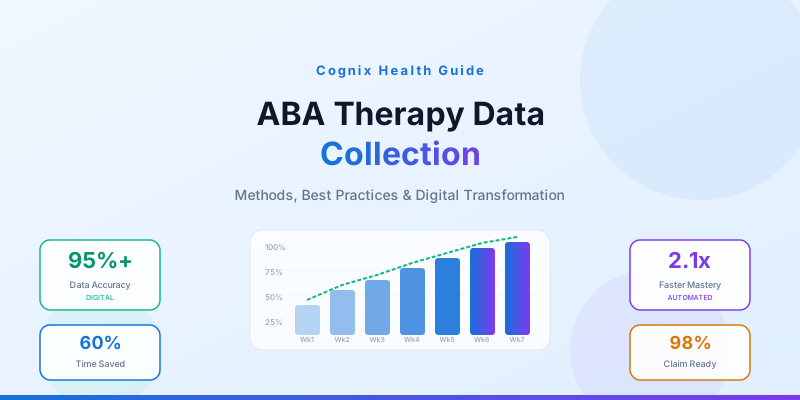
Practices that have transitioned to digital data collection report measurable improvements:
Time Savings
Accuracy Improvement
Mastery Speed
Claim Documentation
Best Practices for ABA Data Collection
Regardless of the tools you use, these principles separate reliable data from noise.
1. Define Behaviors Operationally
Every target behavior must be defined so clearly that two different observers would identify the same instances. "Being aggressive" is not an operational definition. "Hitting, kicking, or biting another person with sufficient force to cause a visible mark" is.
Test your definitions: If a new staff member could read the definition and independently identify the behavior without asking questions, the definition is ready. If not, it needs more specificity.
2. Collect Data Consistently
Consistency in data collection means using the same method, the same measurement procedure, and the same observation period across sessions and across staff members. Switching from frequency to duration mid-treatment, or changing session length without documenting it, introduces variability that masks real clinical change.
This applies to interval recording as well: the subtype (PIR, WIR, or MTS), interval length, and observation period must remain consistent for the same target across sessions. Changing the subtype from PIR to WIR mid-treatment invalidates the trend comparison.
3. Monitor Inter-Observer Agreement (IOA)
IOA measures how consistently two observers record the same behavior. Best practice is to conduct IOA checks at least 20% of sessions, with a target agreement of 80% or higher. When IOA drops below threshold, it is a signal that definitions need clarification or staff need recalibration — not that the client's behavior has changed.
4. Graph and Review Data Regularly
Data that is collected but not reviewed is wasted effort. Visual analysis of graphed data — examining level, trend, and variability — is the primary method for making treatment decisions in ABA. Set a regular schedule for data review: daily for active programs, weekly for maintenance programs, and immediately when a concern arises.
5. Use Data to Drive Decisions, Not Just Document Them
The purpose of data collection is to answer clinical questions: Is this intervention working? Should we modify the prompt level? Is it time to move to the next target? Is the behavior increasing or decreasing? When data collection becomes a checkbox exercise rather than a clinical tool, the quality of care suffers.
6. Match the Method to the Behavior
Not every behavior needs the same data collection method. A high-frequency behavior that needs to decrease calls for interval recording. A chained self-care skill calls for task analysis. A low-frequency behavior that needs to increase calls for frequency recording. Choosing the right method is as important as implementing it correctly.
Common Mistakes and How to Avoid Them
Five Data Collection Mistakes That Undermine ABA Outcomes
The Role of AI in ABA Data Collection
Artificial intelligence is beginning to transform how ABA practices handle data — not by replacing clinician judgment, but by eliminating the most time-consuming and error-prone parts of the workflow.
AI-Generated Session Narratives
One of the most immediate applications is AI-generated session notes. After a session, the clinician reviews the data that was collected and needs to produce a clinical narrative — a professional, third-person description of what happened during the session. This narrative is required for insurance claims, parent communication, and clinical records.
Writing these narratives typically takes 10-15 minutes per session. AI tools can generate a first draft in seconds by analyzing the structured session data — goal trial results, behavior counts, ABC incidents — and producing a narrative that the clinician can review and approve.
What this looks like in practice: The clinician clicks "Generate AI Summary" after completing a session. The system takes the structured data (goal trial results, frequency counts, ABC incidents) and produces a clinical narrative. The clinician reviews it, makes any necessary edits, and approves it. What used to take 15 minutes now takes 2.
Pattern Recognition Across Sessions
AI can also identify patterns across large datasets that would be difficult for a human to detect manually. For example:
- Trend detection: Identifying that a client's performance on a specific goal has plateaued for 5 consecutive sessions, suggesting the need for a program modification
- Contextual correlations: Noting that a behavior occurs more frequently during transitions than during structured activities, even when the clinician has not explicitly tracked setting as a variable
- Mastery prediction: Estimating how many additional sessions are likely needed to achieve mastery based on the current learning curve
These capabilities do not replace clinical judgment — they augment it. The BCBA still makes the final decision, but they make it with better information.
Building a Better Data Collection Workflow
Transitioning from manual to digital data collection is not just a technology change — it is a workflow change. Here is a framework for making the transition successfully.
Step 1: Audit Your Current Process
Before selecting tools, understand where your current process breaks down. Track how much time your staff spends on data collection per session. Identify the most common error types. Survey your clinicians about what frustrates them most about the current system.
Step 2: Define Your Requirements
Different practices have different needs. A clinic focused on early intervention with 15 clients has different requirements than a large provider with 200 clients across multiple locations. Key requirements to evaluate:
- Real-time data entry during sessions, supporting all seven target types
- Automatic mastery tracking with configurable criteria
- ABC data integration with behavior goal trial sync
- Interval recording with configurable slot grids and PIR/WIR/MTS subtype support
- Task analysis with per-step scoring for chained behaviors
- Role-based access so RBTs see their clients and BCBAs see their caseloads
- Reporting that supports both clinical review and insurance documentation
- Mobile accessibility for sessions in homes, schools, and community settings
Step 3: Train Thoroughly
The best system is only as good as the training that accompanies it. Plan for:
- Initial training for all staff on the new system and workflow
- IOA calibration sessions to ensure consistent data collection across team members
- Ongoing support for questions that arise during real-world use
- Regular audits of data quality during the transition period
Step 4: Measure and Iterate
After implementation, track the same metrics you audited in Step 1. Compare time spent on data collection, error rates, and mastery detection speed. Use these metrics to refine your workflow and identify areas where additional training or system configuration is needed.
How Cognix Health Supports Data Collection
Cognix Health was built by people who understand ABA therapy workflows — because they have spent years building tools for ABA practices. The platform's data collection features reflect the realities of clinical work, not just the theory of it.
- Complete method support — DTT with prompt-level tracking, frequency with automatic rate calculation, duration with background timers, interval recording with configurable slot grids and PIR/WIR/MTS subtypes, task analysis with per-step scoring, toileting with specialized response categories, and anecdotal with free-text capture — all in one platform
- Real-time session data entry that works on tablets during sessions, with tap-to-record trial data that automatically tallies and calculates percentages
- Automatic mastery tracking that evaluates criteria after every session and flags goals ready for mastery review — no manual spreadsheet checking required
- Integrated ABC data collection that links incidents to behavior goals and automatically updates session trial data, keeping behavior progress synchronized with clinical observations
- Configurable goal types supporting both skill acquisition (trial-by-trial) and behavior reduction (frequency, duration) with response types including percentage, prompt level, and yes/no
- AI-powered session narratives that generate clinical documentation from structured data in seconds, reducing documentation time by 80% while maintaining clinical quality
- Role-based dashboards showing RBTs their session data, BCBAs their caseload progress, and administrators practice-wide analytics
- HIPAA-compliant infrastructure with multi-tenant data segregation, ensuring every organization's data is isolated and secure
When data collection, goal tracking, clinical documentation, and reporting live in the same platform, the entire workflow accelerates. Clinicians spend less time on paperwork and more time on what they do best: delivering effective ABA therapy.
Ready to see how digital data collection works in practice? Contact Cognix Health to schedule a demo and discover how our platform transforms data collection from a burden into a clinical advantage.
Frequently Asked Questions
How much time should data collection take during an ABA session?
Best practice targets 20-25% of session time for data collection. If data collection exceeds 40% of the session, it is likely crowding out actual therapy time, and the system should be evaluated for efficiency improvements.
What is the minimum data collection frequency for insurance claims?
Most payers require data for every session. Each claim submission must include documented evidence of the services provided, the client's response, and progress toward treatment goals. Gaps in session data are one of the most common reasons for claim denials.
How do I ensure consistent data collection across multiple RBTs?
Three practices are essential: clear operational definitions for every target behavior, regular inter-observer agreement checks (at least 20% of sessions), and a shared data system that enforces consistent measurement procedures. When all staff use the same platform with the same definitions and procedures, variability drops significantly.
Can digital tools handle all seven target types in one system?
Yes. A comprehensive platform should support DTT, frequency, duration, interval (with PIR/WIR/MTS subtypes), task analysis, toileting, and anecdotal recording — all within the same session view. The key is that each target type maps to its specific response data structure, and the system handles the differences transparently so the clinician focuses on the client, not the data format.
How do I choose the right data collection method for a given behavior?
The behavior itself tells you which method to use. Discrete, countable responses → DTT or frequency. Behaviors that vary in length → duration. High-frequency behaviors without clear boundaries → interval recording. Multi-step chained skills → task analysis. Toilet training → toileting. Contextual observations that don't fit other methods → anecdotal. When in doubt, start with the most structured method that fits the behavior and simplify only if necessary.
How do I transition from paper to digital without disrupting active programs?
Start with one program or one client, not the entire caseload. Run the paper and digital systems in parallel for 2-4 weeks to verify that the digital system captures the same data with equal or better accuracy. Once the team is confident, expand to additional programs. Most practices complete the full transition within 6-8 weeks.
What about interval recording — when should I use PIR vs WIR vs MTS?
Use PIR (Partial Interval) when you want the most sensitive measure of a behavior you're trying to reduce — even one brief instance counts. Use WIR (Whole Interval) when you want to measure sustained performance of a behavior you're trying to increase — the behavior must last the entire interval. Use MTS (Momentary Time Sampling) when you cannot continuously monitor the behavior — it provides a representative sample at the moment each interval ends. The key rule: choose the subtype before the session and keep it consistent across sessions for the same target.
This guide reflects ABA data collection best practices as of June 2026. For questions about how Cognix Health supports data collection workflows in ABA practices, reach out to our team at [email protected].